
In fundamental terms, a decision to build a building is a decision against nature in every respect. The nuances between what is nature and what is the created, artificial, human-made world are the keys to a successfully ‘in tune’ building. Architecture is the medium between the artificial and natural worlds. Building Physics makes this medium the best it can be by working with both the artificial and the natural worlds.
As professionals in the building industry, it is our choice to make a difference for the future or to remain stagnant, create mistakes, and learn through those mistakes as others have done in the past; rather than understanding those mistakes through proof, taking them onboard and running with the knowledge in every new building we lay our hands on. The biggest impact we can have on buildings, is through long-lasting, carefully created thermal envelopes (the structure which separates the internal environment from the external climate). This goes beyond energy usage standards and dives into the behaviours of materials and moisture.
Where are we heading?
Builders are becoming way more advanced in the processes they use on site, which has a direct relationship to an increase in build quality. This build quality is making homes and other buildings more separated from the external climate than ever before (generally, more airtight). It is creating homes which are more comfortable than ever before, however, it is also creating spaces which are at more risk of mould than ever before, and this is the killer.
Rating tools across the world (including NatHERS) are moving toward a strategy of more airtight buildings to reduce energy consumption. This has been proven time and time again, through other standards and verification methods and in particular tools used to measure and limit the power consumption of mechanical heating and cooling. Airtightness is also fundamental in the success of the Passivhaus standard.
A breath of fresh air?
More airtight buildings require a more guaranteed fresh air supply. One of the benefits of an even distribution of air through a building is the removal of airborne moisture, reducing mould creating environments. Opening windows is great in Summer; being able to close them in Winter is even better.
Mechanical ventilation gives the building occupant a choice to open windows or not. Relying on window ventilation alone, is less effective in removing airborne moisture. Paying for the electricity to run a mechanical ventilation unit is equal to running a 100W light, 24 hours a day, all year round (often less than 50W) and that cost is so worth it!
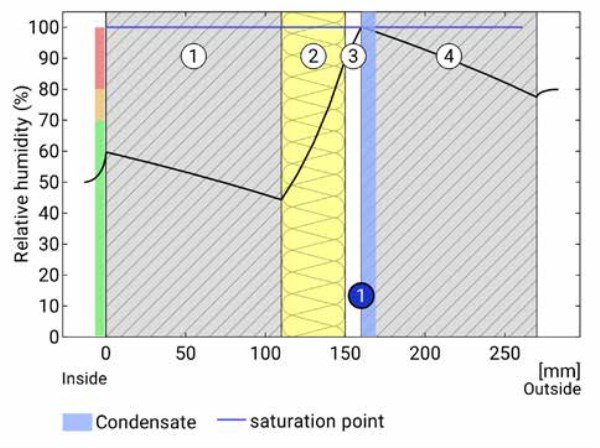
What is moisture management? As described above, mechanical ventilation can manage moisture. We see this as one part of the equation. Consider airborne moisture and interstitial moisture as two separate things. Interstitial moisture is moisture which occurs in the walls (mainly walls), floors and roofs of a building and managing this with modelling tools is best way to prevent moisture buildup. By considering airborne and interstitial moisture as separate, it makes sense to only operate mechcnical ventilatilation when a building is occupied by people (the main cause of airborne moisture).
What is our experience?
At Building Physics Australia, we have collaborated with builders, architects and homeowners on a number of standards and on a number of types of buildings including, code compliance on rammed earth homes, NatHERS assessments across developments, performance modelling and risk assessment on all of the projects which come across our desk, as well as fully certified Passivhaus and Passivhaus Premium homes, on and off the grid.
The experience explains that anything is possible with the right intention. Underlying all of this experience is recommendations around how to manage moisture to prevent mould, which is underlying to most disease within the household.
How can we help you?
By implementing a holistic approach to physics and moisture management, it is possible for us to collaborate with you in creating an approach to understand the risks of any particular design. Typically, the Passivhaus Planning Package is used as a building physics tool, initially, to understand the form, risks and energy assessment of a design and further to provide feedback on the effect of options as part of the design process.
Because moisture is such an issue and will present as a greater issue in the future, we include a thermal bridge study (if details are present), as well as a review of a wall assembly at risk of interstitial moisture build up and mould.
What can I do now to have a better building?
In this order: 1. Reduce the area of the building to bare necessities; 2. Increase Window Budget and performance to at least double-glazing timber, uPVC or thermally broken aluminium windows; 3. Install a Mechanical Ventilation Unit; 4. Improve Airtightness and 5. Communicate benefits to others.