Demand for digital product traceability is heating up – and construction is next
Globalisation has brought many benefits, including in quality and pricing, a larger marketplace, and diversified supply. But it also has its challenges, not least a lack of understanding of local legislative requirements (e.g. understanding code requirements), and an increased carbon footprint for longer logistics journeys.
Additionally, complex procurement means risks and uncertainty over products’ origins, quality, compliance, and related assurances.
The problems caused by the lack of visibility and assurance of fact through the supply chain are driving global demand for digital product traceability to international standards. End-consumers and responsible businesses want certainty when it comes to safety and quality, as well as ESG performance.
In construction, with the push to optimise process efficiencies and ensure compliance with local regulations, digital traceability from source to end product is being seen as a game-changer.
Tried and tested
Many industries have successfully introduced forms of digital product traceability. In textiles, the end consumer previously had no visibility over the early stages of the supply chain. But as customer expectations rose – primarily around fair trade, and more recently for assurance around other ESG factors – the industry introduced better traceability so the end user can now determine the origin of garments.
In the grocery store, to improve efficiency we moved from counter service to self-service, and then added barcodes for better customer access. These barcodes, which use global standards, also provide the traceability to ensure our foods are safe, responsibly sourced, and of the desired quality.
In the automotive industry, where safety is also a primary concern – followed closely by costtraceability is used to drive efficiencies across a complex manufacturing process and to assure end-user safety.
In the production of a car, parts are sourced from across the globe, with unique markings at component level to ensure traceability throughout manufacture. This tracking enables specific recalls in the case of faults, thus giving the user confidence in the end product.
Protecting consumer confidence
We can see from industries that have already adopted the process, that digital traceability has numerous benefits including:
1. Validating safety and quality of products – good for end-users and any liable parties
2. Optimising processes – good for manufacturers
3. Improving ESG performance – good for everyone
4. Increasing consumer confidence.
On the last point – consumer confidence – transparency and trust are the key issues. We’ve seen several examples in recent years where transparency and trust were missing or broken, and consumer confidence quickly followed.
At the beginning of 2018, a major steel manufacturer from Japan admitted to supplying products with falsified test reports for decades. Supply chains all over the world were affected, and the company lost years of customer trust.
Similarly, major automotive companies were caught deceiving customers regarding emissions testing. In both these situations, not only was the principal company affected but also companies that used them as suppliers.
Safe as houses
Construction is certainly not immune to such issues. Like the automotive industry, construction has long complex, global supply chains that source parts and components from multiple suppliers. Safety is paramount: compliance of products and materials is of major concern, and demonstration of safety is a legal requirement.
However, construction provides more complexity in supply chains and service providers than other industries, and yet, to date, we have not seen widespread adoption of digital product traceability. The current systems, being primarily paper-based, remain open to fraudulent behaviour – which in turn reduces confidence in the conformity of materials and products. As a result, the industry has seen unfortunate recent and historic examples of these shortcomings.
Inquiries have been held regarding a number of concerns, including Grenfell Tower in the United Kingdom; Lacrosse Tower; Opal and Mascot Towers in Australia, and E-Class mesh in New Zealand. Findings suggest that knowledge and understanding of material and products, and demonstration of conformance, are paramount. They suggest that traceability is needed to protect the supply chain and the end consumer. Digital systems would enable traceability even within a complex construction industry setting.
We are also seeing the regulatory environment change, with conformance responsibility being attributed through manufacture to the finished product.
Construction needs a readily available means of providing product traceability. But what does effective digital traceability look like?
Global trust anchors
Digital traceability systems have been around for some time, but in a complex environment such as construction, linear systems don’t easily provide access to the information sought. Work is currently being conducted on the global stage that considers “trust anchors” and “verifiable credentials”.
A trust anchor is a point along the supply chain providing assurance, from a verified and trusted source, that the product is compliant with a particular aspect. Typically, the trust anchor would not hold all information about a product, but instead act as a pointer to enable traceability and access to the information required.
An example of a familiar tool that acts as a trust anchor would be the apps used for two-step authentication. Without the input of any personal information, the app provides verification for the user to proceed.
Steely conviction
Steel is one of the most important materials in construction. Despite that, we regularly see:
• a huge variance in quality (performance characteristics) and consistency;
• consignments delivered with mixed supply (is it all compliant?); and
• steel delivered that doesn’t conform to local standards.
Fake or misleading paper test certificates are common, showing results for a different product, or supplier, or are falsified. We have found fraudulent certificates on steel consignments on-site on major infrastructure and construction projects, as well as steel with inappropriate product markings and inadequate traceability.
The answer to overcoming these challenges is rigorous independent certification from mill to site, the kind provided by ACRS – Australasia’s leading steel certifier.
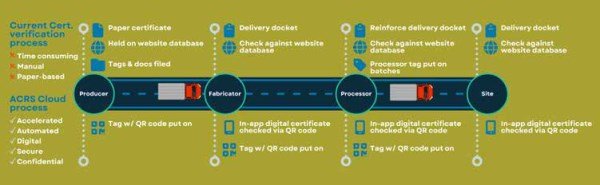
The ACRS scheme provides effective product certification, ensuring quality and compliance along with the legislated traceability through the supply chain. To achieve this traceability, ACRS certifies steel both at manufacture and at processing. ACRS has been providing this traceability for more than 20 years, including the use of web-based verification methods.
Recognising the industry move to digital systems and to ensure this confidence in the ACRS scheme is maintained, ACRS has launched ACRS Cloud – a digital verifiable conformance scheme. By combining certification and digital product traceability, ACRS will be a trust anchor, providing confidence and traceability to the market.
ACRS Cloud
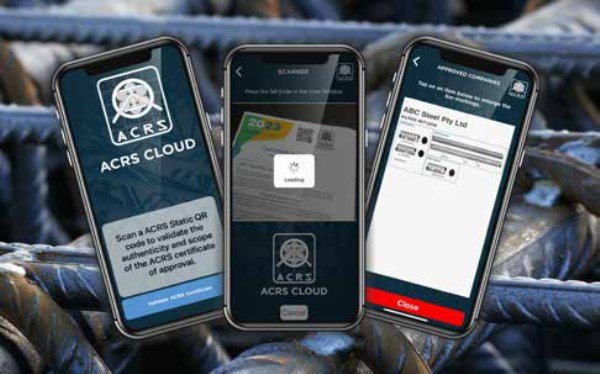
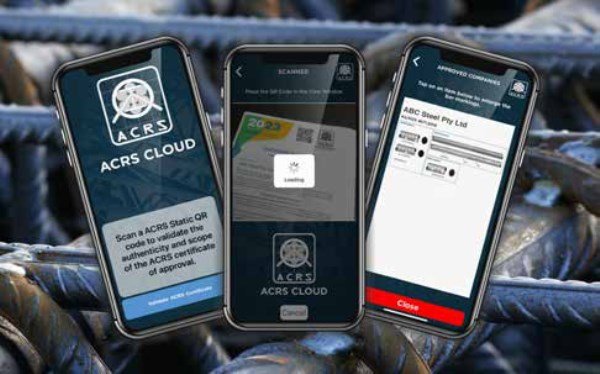
ACRS Cloud is the first digital certification system of its kind for steel in the Australian and New Zealand construction industries. ACRS Cloud gives steel buyers and users instant assurance over product certificates at the touch of a button, in a secure environment, to provide confidence in products’ conformance to AS/ NZS Standards.
Users through the supply chain can get product peace of mind by checking the nature and authenticity of ACRS steel certificates in the new ACRS Cloud app – available free on Apple and Android.
The app further protects the market from product compliance issues: The ACRS Cloud system will see batch-specific tags with QR codes put onto steel at steel producers, fabricators, and processors. At each point, these QR codes (and/or those on ACRS certificates) can be scanned onsite to instantly identify the source of a product and its certification details against a ‘single source of truth’, including batch number; bar and tag markings; and verification of product conformance to provide full traceability through the supply chain.
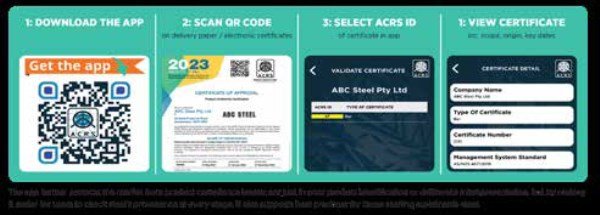
Just like via the ACRS online database, you will be able to search for certificate holders by mill name or country, and report any concerns, all in the app. Simply: 1. Download the ACRS Cloud App 2. Scan the QR code on delivery papers or electronic certificate 3. In the app, select the ACRS ID of the certificate 4. View the certificate in full, including scope, origin, and key dates.
ASSURANCE IN YOUR HANDS: WHEREVER, WHENEVER
In order to make product traceability more secure and accessible, ACRS certificates will carry QR codes which – when scanned – will open validation and vital product information in ACRS Cloud.
The app will put assurance in users’ hands wherever and whenever they need it, including bar and tag markings; where the product has come from; and its validity and its assurance credentials in the form of ACRS’ sector-leading independent certification. Just like online, you will be able to search for certificate holders by mill name or country, and report any concerns, all in the app. Available on Apple and Android, the app is completely free to download and use.
For certainty over the steel you use, make sure you are specifying ACRS-certified steel, and checking conformance easily in the new ACRS Cloud app. Find out more at: steelcertification.com/cloud