
All stakeholders in the construction industry, from block layers right up to the NSW Building Commissioner, are very much aware of the prevalence of noncompliant placement of reinforcement in reinforced masonry.
BlockAid bar chairs came about when a structural engineer and a block layer shared their frustration with the continued poor placement of reinforcement in reinforced masonry.
BlockAid set about designing bar chairs as a locating device to overcome the non-compliance issues while ensuring their use would be commercially viable for block layers to include in the construction of masonry.
Currently, the common method of masonry construction is to place the horizontal reinforcement in the web recess of the blocks once a course is laid, then continuing with laying the block courses, placing additional horizontal reinforcement in the web recess of every second course. Once all courses are laid, the vertical reinforcement is inserted into the cores of the completed wall. In a wall under compression load, the vertical reinforcement must be located centrally in the core.
The placement of each horizontal rebar is therefore critical to allow subsequent insertion of the vertical reinforcement central in the core. Accordingly, if the horizontal steel is mis-placed, encroaching over the core centre, it will block the path of the vertical, preventing it from being inserted centrally in the core. Given there will be multiple rows of horizontal reinforcement, it is unlikely, with no means of lateral location, that the horizontal will be correctly placed throughout the wall, to allow insertion of the vertical reinforcement central in the core.
In addition to the risk of mis-placed reinforcement under current construction methods, discussions with members of Masonry Contractors Australia reveal that masons do not necessarily tie off the vertical reinforcement to the horizontal reinforcement to ensure it stays in place during the core filling process. As a result, the placement of the vertical is only one issue as the movement of the vertical under the force of filling the cores with grout results in the vertical steel being pushed out towards the shell face of the blocks.
This is a serious issue with current construction methods that severely diminishes the structural capacity and durability of reinforced masonry.
If masonry contractors are required to use bar chairs for reinforced masonry, the improvement in construction methods will be significant, without requiring onerous cost or methodology to comply.
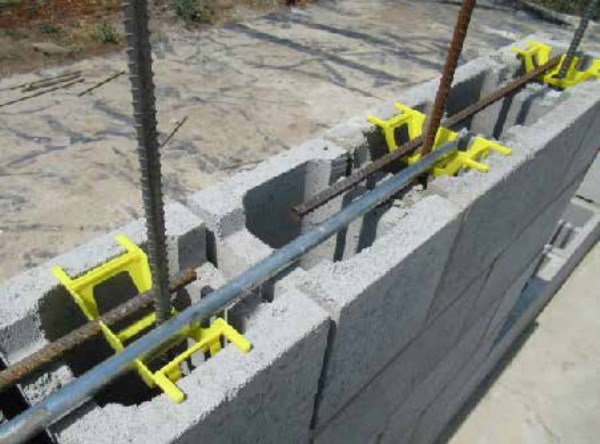
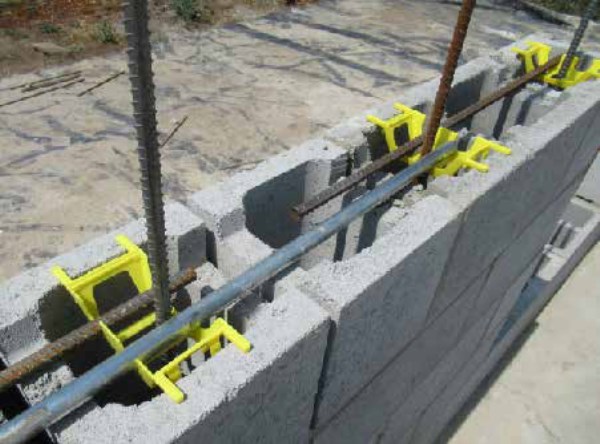
Bar chairs that locate the horizontal steel as each course is laid and provides a clear aperture for inserting the vertical steel once all courses are laid, ensures all the reinforcement is placed correctly and held in position securely, to prevent movement during the core filling process. Wire tying of the steel will no longer be required. The time taken to place the bar chairs in the top of the blocks is far less than the time required to tie off the vertical to the horizontal, so for those diligent masons who do tie the vertical to the horizontal, the bar chairs will save construction time while ensuring the reinforcement is compliant.
The cause of the appalling situation for the owners of apartments in the Mascot Towers in Sydney, has been identified as a failure in reinforced masonry. The Tower’s evacuation in June 2019 was due to cracking in the primary support structure and facade masonry, a significant non-compliance in construction that can be prevented from re-occurring by the specification of BlockAid bar chairs for reinforced masonry construction.
Another benefit of bar chairs being used to locate and secure the reinforcement is that when a Certifier inspects the masonry, prior to the core fill, the bright yellow bar chairs are easily
identified and will clearly show the reinforcement is correctly placed and importantly, secured in place to assure the Certifier that the masonry is compliant on inspection and will remain compliant during the core fill process.
BlockAid bar chairs have been proven by the Queensland University of Technology (QUT) to meet the Performance Requirements for Reinforced Masonry. QUT found that BlockAid bar chairs effectively restrain and support the vertical and horizontal reinforcement without using tie wires. Mascot Towers is a prime example of the ultimate cost of misplaced reinforcement and building owners deserve improved construction of their masonry.
It makes a lot of sense to specify and use BlockAid bar chairs for your next reinforced masonry project. BlockAid bar chairs will ensure your reinforced masonry achieves compliance without compromising cost.

Phone: (02) 4934 2980
Email: sales@blockaid.com.au