Discover the most common health and safety risks in construction and learn how to manage them effectively. Your guide to creating a safer Australian worksite. Successfully managing the health and safety risks in construction is critical for any Australian worksite. The most immediate dangers often boil down to a handful of severe threats. We’re talking about falls from height, being struck by moving objects, electrocution, and getting caught in or between machinery. Known in the industry as the ‘Fatal Four’, these risks demand constant vigilance and a proactive approach to safety management.
Understanding the Health and Safety Risks on Construction Sites
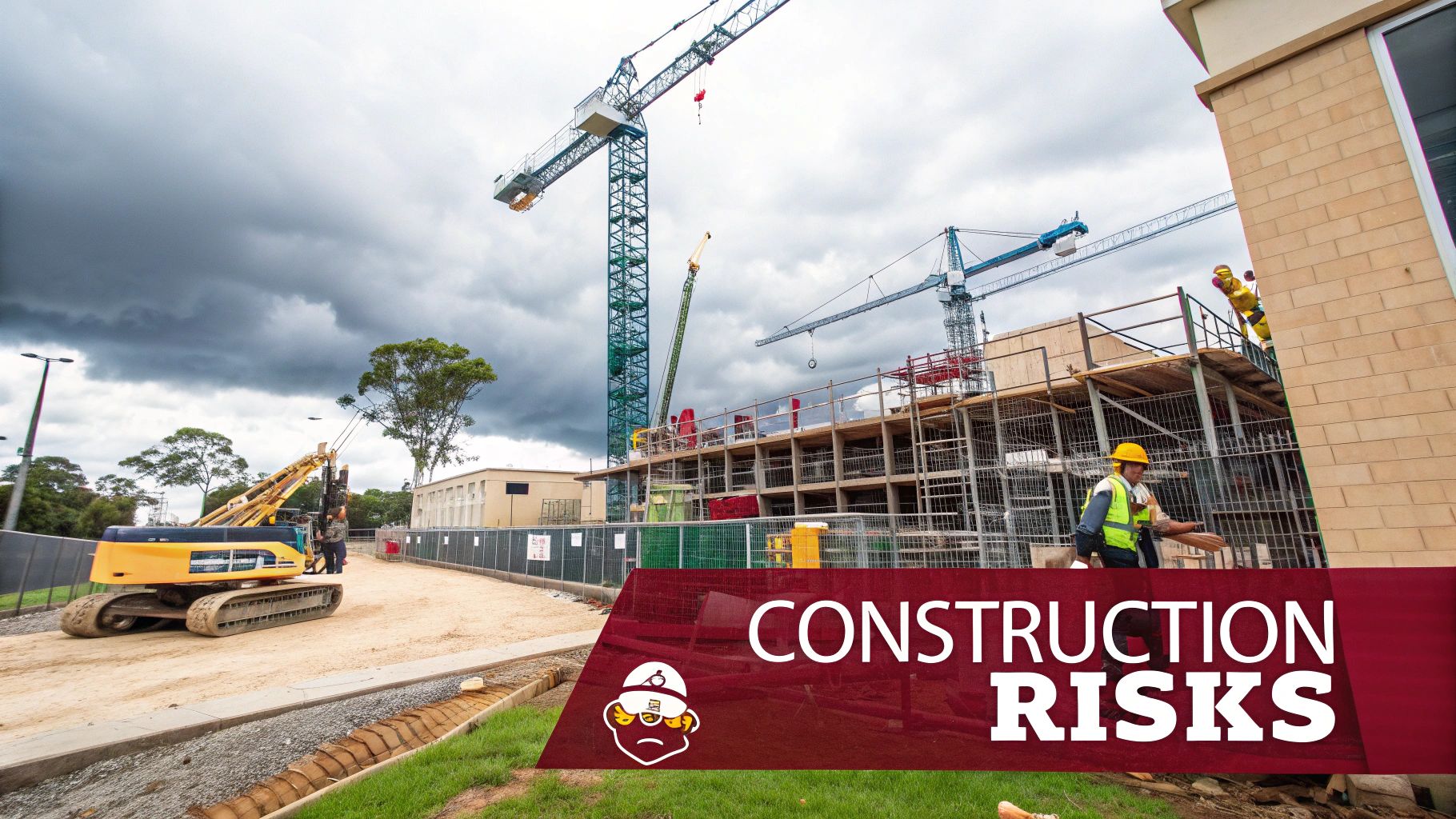
Australia’s construction industry is a powerhouse for national growth, but it’s built on a foundation of significant, ever-present danger. Every single project, whether it’s a small home renovation or a massive infrastructure build, has its own unique and complex risk profile that can change by the hour. This dynamic environment—full of heavy machinery, shifting materials, and crews working at height—makes construction one of the country’s most hazardous professions.
A High-Stakes Environment
Forget abstract statistics for a moment and think about the daily reality for workers. The very nature of construction means the worksite is the product, so hazards are constantly being created and, hopefully, managed. This is worlds away from a static factory floor. A trench dug in the morning can become a deadly collapse risk by the afternoon. A newly erected scaffold immediately introduces new fall hazards that weren’t there the day before.
This constant state of flux is precisely why a systematic approach to safety is so much more than a box-ticking exercise. It’s a matter of operational survival. For small and medium-sized construction businesses in Australia, solid safety management is non-negotiable for a few key reasons:
- Protecting Your People: It’s simple—your crew is your most valuable asset. The top priority is making sure they get home safely every single day.
- Winning Major Contracts: Tier-one contractors and government clients won’t even look at your tender if you can’t show proof of a sophisticated safety system, like one aligned with ISO 45001.
- Maintaining Business Viability: A single serious incident can result in crippling fines, project shutdowns, and reputational damage that can be impossible to recover from.
The Unfortunate Statistics
The numbers don’t lie. Construction consistently ranks among Australia’s most dangerous industries. Recent data reveals that construction is one of just six industries responsible for a staggering 80% of all work-related traumatic fatalities nationwide. This intense concentration of harm shows exactly why construction businesses must have rock-solid occupational health and safety (OHS) systems in place.
Things like vehicle incidents and falls from height contribute to a fatality rate for machinery operators and drivers that is more than five times the national average. You can dig deeper into the numbers by checking out the latest statistics from Safe Work Australia.
To put the most critical dangers into perspective, here’s a quick overview of the “Fatal Four”.
The ‘Fatal Four’ Construction Risks at a Glance
This table breaks down the four leading causes of fatalities on construction sites, offering a clear view of where the greatest dangers lie.
| Risk Category | Common Causes | Primary Prevention Focus |
|---|---|---|
| Falls from Height | Unprotected edges, unstable ladders, fragile roofs, faulty scaffolding. | Guardrails, fall arrest systems, proper scaffold erection, secure ladder use. |
| Struck-By Incidents | Moving vehicles, falling materials, swinging crane loads, flying debris. | High-visibility gear, defined traffic routes, tool tethers, toe boards. |
| Electrocution | Contact with overhead/underground power lines, faulty tools, improper wiring. | De-energising circuits, maintaining safe distances, using insulated tools. |
| Caught-In/Between | Trench collapse, rotating equipment, moving parts of machinery, crushed by objects. | Trench shoring, machine guarding, lockout/tagout procedures, clear work zones. |
Understanding these profound risks is the first and most critical step. From here, you can start building a resilient safety culture that not only protects your workers but also secures the future of your business.
Identifying Common Physical Hazards on Your Worksite
We’ve touched on the ‘Fatal Four’, but now it’s time to get our boots on the ground and see what these major health and safety risks actually look like on a real construction site. A worksite is a dynamic, constantly changing environment. The single most important skill anyone can have—from the newest apprentice to the site manager—is the ability to spot a hazard before it causes an incident. This isn’t about ticking boxes; it’s about developing a sharp eye for what could go wrong.
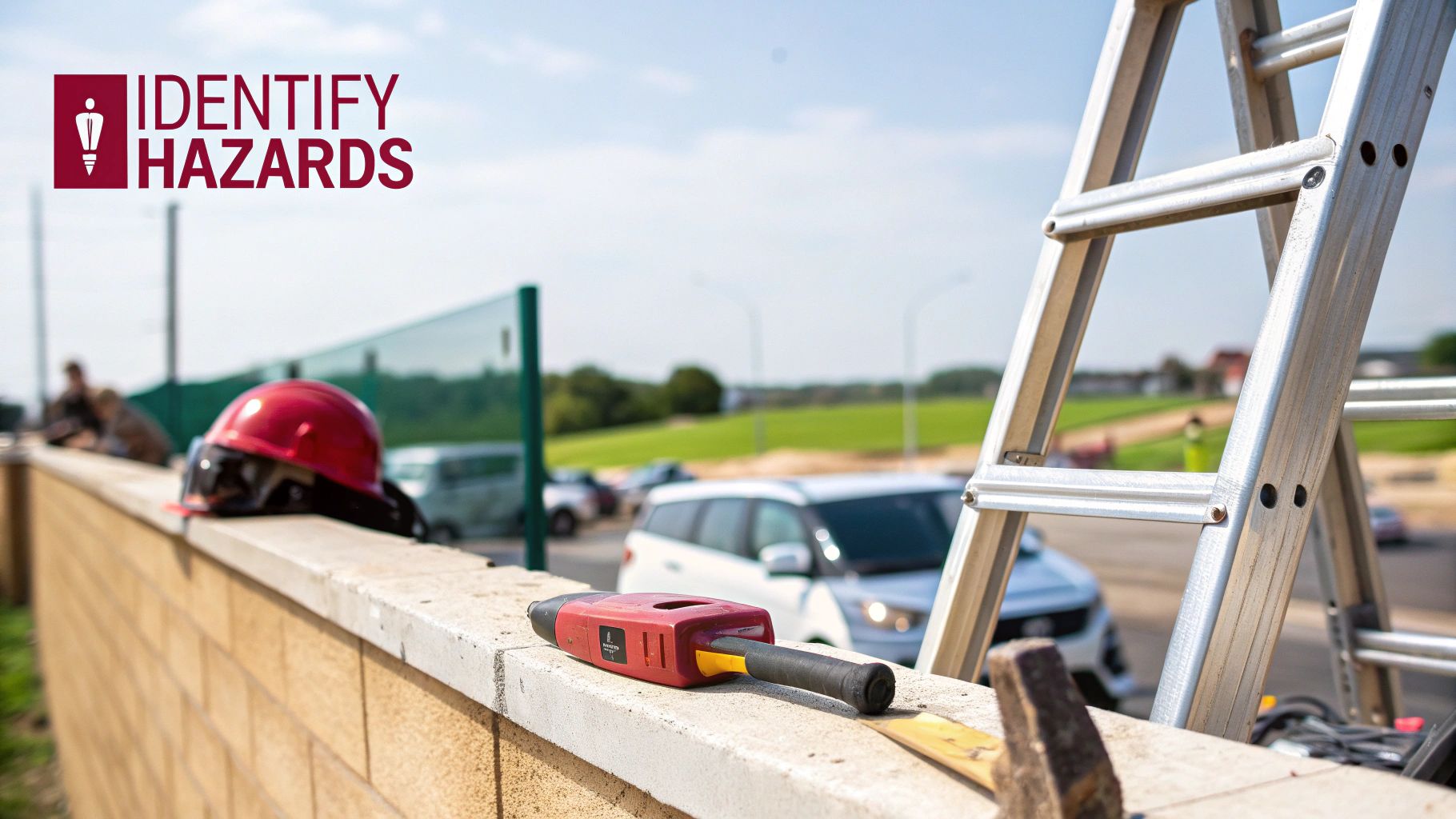
This kind of proactive awareness is critical. While Australia has made great strides in reducing work-related injuries overall, the construction industry is still a major outlier. The numbers from Safe Work Australia tell the story: a massive 84% of all serious claims come down to body stressing, falls, slips, trips, being hit by objects, or mental stress. These are the everyday realities of a construction project, and understanding what causes them is the first step to preventing them.
Falls from Heights
When people think of construction dangers, this is usually the first one that comes to mind. But it’s not just about falling from a skyscraper. A fall from just over two metres can be fatal.
- Improperly Secured Scaffolding: Always be on the lookout for missing guardrails, loose planking, or scaffolding that’s been put up on soft or uneven ground. These are glaring red flags for an immediate and serious risk.
- Ladder Misuse: We see it all the time. Using a ladder that’s too short, setting it up on a dodgy surface, or leaning out just a little too far instead of moving it. These are classic shortcuts that lead to devastating falls.
- Unprotected Edges and Openings: Any open floor, roof edge, or excavation that doesn’t have proper guardrails or covers is just an accident waiting to happen.
Struck-By Incidents
Construction sites are a constant hive of activity, with people, machinery, and materials always on the move. A ‘struck-by’ incident is exactly what it sounds like—a person getting hit by a moving object or piece of equipment.
For instance, think about tools or materials falling from a level above and hitting someone below. This is often a direct result of missing toe boards on scaffolding or workers not tethering their tools properly. Another common scenario is a reversing vehicle or piece of machinery with a blind spot and no spotter. Beyond the site itself, mobile plant like large trucks bring their own set of risks. Knowing the fundamentals, like HGV load securing best practices for safe transport, is essential to stop loads from shifting and causing an incident.
Electrocution Risks
Electricity is the silent killer on a worksite. It’s everywhere, but you can’t see it, and the danger often comes from where you least expect it.
Some of the worst electrical incidents happen when equipment like a crane or an EWP (Elevated Work Platform) gets too close to overhead power lines nobody identified. This is exactly why pre-start site assessments and clear communication about electrical hazards are non-negotiable.
Other common risks are as simple as a damaged extension lead, a power tool with a frayed cord, or working in damp conditions without the right electrical protection. These things might seem minor, but they can be lethal. Spotting these hazards means doing a quick check of all electrical gear before you use it and making sure everyone knows where the power sources are.
Caught-In or Between Accidents
These are horrific incidents where a worker is crushed, squeezed, or compressed between objects. They happen most often in excavation work and around heavy machinery.
- Trench Collapses: An unprotected trench is a death trap. The weight of collapsing soil is immense, giving a worker virtually no chance to escape. Proper shoring or benching is absolutely essential.
- Machinery Pinch Points: This is where someone gets caught in the moving parts of a machine, or trapped between a machine and a wall. It’s why machine guarding and solid lockout/tagout procedures are so critical.
Spotting these physical hazards is the very foundation of any good risk assessment. Every single threat you identify needs to be written down, thought through, and controlled.
Beyond the Obvious: Invisible Health and Safety Threats
When we think about construction site safety, our minds usually jump to the obvious stuff: falls from heights, trench collapses, or machinery accidents. And while those are absolutely critical risks to manage, some of the most serious dangers are the ones you can’t see.
These are the invisible threats—the hazards that creep up over time, causing long-term, often irreversible, damage. We’re talking about the slow-burn risks that can quietly compromise a worker’s health over the course of their career.
Ignoring these latent dangers is a massive blind spot in any safety plan. It’s not just about getting everyone home safe at the end of the day; it’s about ensuring they have a healthy life long after they hang up their tools.
The Problem with Dust and Chemicals
So many everyday construction jobs release harmful substances into the air or onto the skin. Unlike a slip or fall, the damage isn’t immediate. It builds up, with devastating health problems surfacing years, or even decades, down the track.
- Silica Dust: Anytime you’re cutting, grinding, or drilling concrete, brick, or stone, you’re creating respirable crystalline silica. These microscopic particles get deep into the lungs and stay there, leading to silicosis—an incurable and debilitating lung disease—as well as lung cancer. It’s one of the industry’s biggest hidden killers.
- Asbestos: We all know the danger here, but it’s worth remembering that countless older buildings across Australia still contain asbestos. Disturbing it during a renovation or demolition sends deadly fibres airborne. Inhaling them can lead to mesothelioma and asbestosis, both fatal conditions that take a long time to develop.
- Chemicals and Solvents: Think about all the chemicals workers handle daily—paints, glues, cleaning solvents, epoxies. Constant exposure can cause anything from nasty skin rashes and breathing difficulties to serious, long-term neurological damage.
More Than Just Noise and Rattles
The work environment itself can slowly wear a person down. The constant drone of machinery and the shudder of power tools might just seem like “part of the job,” but they cause permanent physical harm.
Think of a worker’s hearing like a patch of grass. A single loud noise is like someone walking across it once—it bounces back. But constant, daily noise exposure is like a herd of cattle trampling the same path every day. Eventually, the grass is destroyed and won’t grow back. That’s permanent hearing loss.
The roar from jackhammers, grinders, and concrete saws leads directly to noise-induced hearing loss (NIHL). It’s entirely preventable, but once it’s gone, it’s gone for good. In the same way, spending years holding a vibrating power tool can cause Hand-Arm Vibration Syndrome (HAVS), damaging nerves and blood vessels in the hands and arms, resulting in chronic pain and a loss of grip strength.
Looking After Our Mates: Mental Health on Site
Finally, the conversation around safety is expanding to include mental health, and it’s about time. The construction industry is facing a genuine mental health crisis. Alarming data from around the world consistently shows that suicide rates among construction workers are among the highest of any profession.
What’s driving this? It’s often a perfect storm of factors:
- A High-Pressure Culture: Relentless deadlines, long hours, and the constant pressure to perform create a seriously stressful atmosphere.
- Work Insecurity: The boom-and-bust cycle of project work can cause a lot of financial stress and anxiety about where the next job is coming from.
- The “Toughen Up” Attitude: There’s still a deeply ingrained “tough-guy” culture that stops people, especially men, from admitting they’re struggling or asking for help.
Learning to spot the signs of mental distress—like a mate who seems more anxious or on-edge, is acting recklessly, drinking more, or has just gone quiet—is a real safety skill. Building a site culture where it’s genuinely okay to talk about mental health is just as vital as handing out hard hats. True safety means protecting the whole person, mind and body. An organisation that gets this right doesn’t just build structures; it builds a stronger, safer, and more resilient team.
Putting the Hierarchy of Controls into Practice
Spotting the countless health and safety risks on a construction site is one thing, but it’s only half the job. Knowing a hazard exists doesn’t stop an accident—taking smart, decisive action does. That’s where the Hierarchy of Controls comes into play. It’s a cornerstone of modern safety management and a central idea in the ISO 45001 standard.
Think of it as an upside-down pyramid. The most effective, bulletproof solutions are at the wide top, while the weakest are at the narrow tip. The golden rule is to always start at the top and work your way down. Don’t just jump to the easiest fix, which is often the least effective. This structured approach pushes you to tackle risks at their source, creating a fundamentally safer site.
The diagram below highlights some of the invisible threats—hazards that don’t cause an immediate injury but can lead to serious long-term harm. These must be managed with the same rigorous control hierarchy.
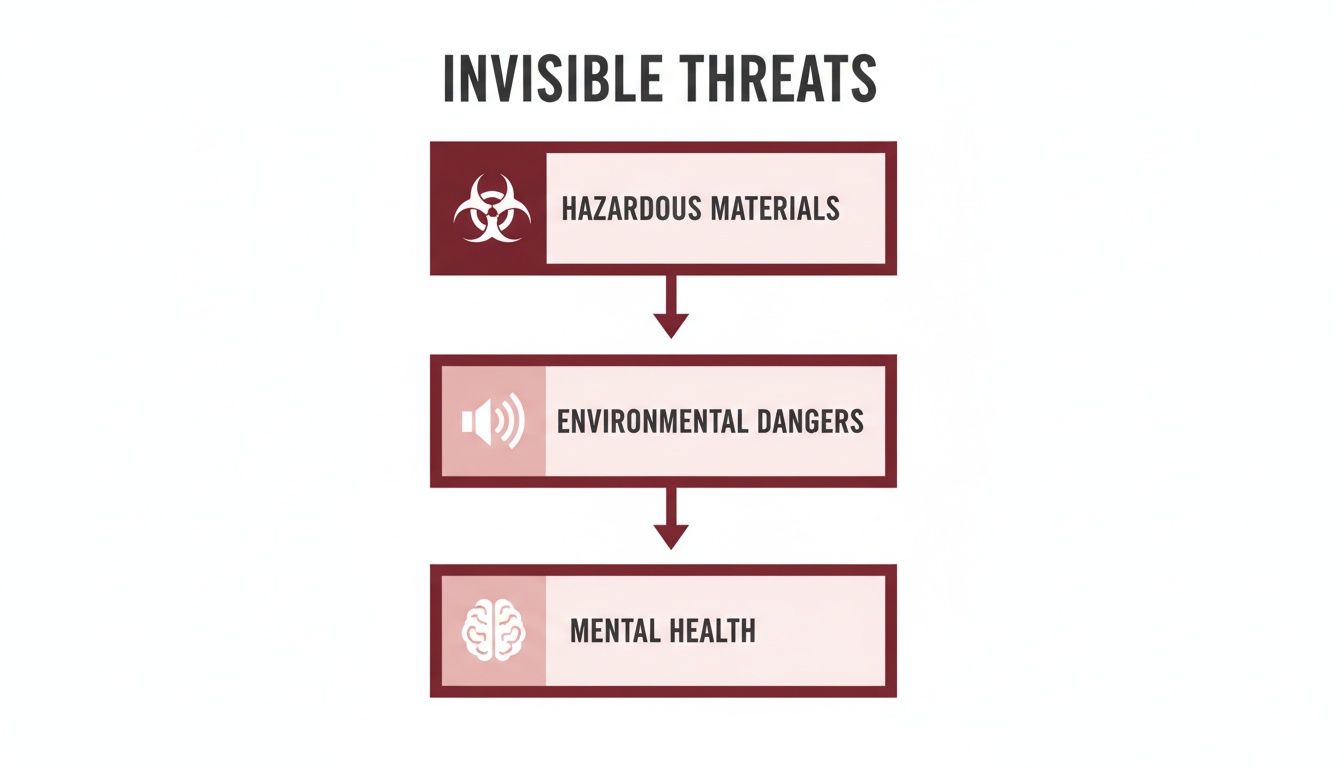
It’s a powerful reminder that occupational illnesses from hazardous substances, environmental factors like constant noise, and deteriorating mental health are just as critical to control as the more obvious physical dangers.
Starting at the Top: Elimination and Substitution
By far the most effective way to deal with a hazard is to get rid of it entirely. This is elimination. It’s not always practical, but it should always be the first question you ask: “Can we get this job done without this risk?” For instance, can you prefabricate wall frames or trusses at ground level to completely remove the need for certain tasks at height?
If elimination is off the table, the next best thing is substitution. This simply means swapping out something dangerous for a safer alternative. On a building site, that might look like:
- Using a non-silica-based abrasive for blasting instead of sand.
- Choosing a less toxic, water-based paint over a traditional solvent-based one.
- Ordering pre-mixed concrete to avoid the manual handling of heavy cement bags.
Engineering a Safer Environment
When you can’t eliminate or substitute, you move down to engineering controls. These are physical changes to the workplace, tools, or process that put a barrier between your workers and the hazard. The beauty of these controls is that they don’t rely on someone remembering to do the right thing; the protection is built right in.
A classic construction example is designing a new building with permanent anchor points pre-installed on the roof. That’s a far more robust engineering solution than just handing out harnesses and hoping everyone uses them correctly. Other examples include installing guardrails around voids, using power tools with effective guarding over moving parts, or fitting a concrete saw with a water-fed dust suppression system.
Engineering controls are powerful because they are passive. They protect workers automatically, reducing the potential for human error and making the safe way the easy way.
Shaping Behaviour with Administrative Controls
The next step down is administrative controls. These are the rules, procedures, and training you implement to change how people work. This level is weaker because it depends entirely on people following instructions and doing the right thing, every time.
This is where you’ll find things like:
- Developing Safe Work Method Statements (SWMS) for high-risk construction work.
- Using job rotation to limit a worker’s exposure to noise or whole-body vibration.
- Scheduling the noisiest work, like rock breaking, outside of peak hours.
- Putting up clear warning signs and barricading off exclusion zones.
The Final Barrier: Personal Protective Equipment (PPE)
At the very bottom of the hierarchy, we find Personal Protective Equipment (PPE). This is your hard hats, safety glasses, gloves, respirators, and harnesses. PPE is absolutely necessary, but it should never be your first or only line of defence.
Why is it the last resort? Because it only protects the person wearing it, does nothing to remove the actual hazard from the site, and its effectiveness hinges on it being the right type, fitted properly, and used correctly 100% of the time. When applying the hierarchy of controls, personal protective equipment (PPE) like High Visibility Workwear is essential to mitigate risks associated with poor visibility on construction sites, but it should complement higher-level controls like traffic management plans.
To see how this all fits together, let’s look at a common construction hazard—silica dust from cutting concrete—and apply the hierarchy.
Table: Applying the Hierarchy of Controls to a Common Construction Hazard
| Control Level | Example Action for Silica Dust Control | Effectiveness |
|---|---|---|
| Elimination | Design the project to use pre-cast concrete panels that don’t require on-site cutting. | Very High |
| Substitution | Use a non-silica-based building material or a different construction method altogether. | High |
| Engineering | Use a saw with a built-in water suppression system or an attached vacuum extraction unit. | High |
| Administrative | Implement exclusion zones, job rotation, and specific training on silica dust hazards. | Medium |
| PPE | Mandate the use of a properly fitted P2 or P3 respirator for all cutting tasks. | Low |
As you can see, relying solely on a respirator (PPE) is the weakest option. By working down from the top, you build multiple layers of protection that make the site inherently safer for everyone.
Getting to Grips with Aussie WHS Laws and Standards
Knowing the risks on a construction site is one half of the battle. The other half is making sure everything you do lines up with Australia’s legal framework. This isn’t just about ticking boxes to avoid a fine; it’s about building a business that genuinely puts its people first and can defend its safety practices. Think of the law as the scaffolding that supports a safe, successful operation.
The cornerstone of workplace safety in Australia is the model Work Health and Safety (WHS) Act. This law puts the main responsibility, or ‘duty of care’, squarely on the shoulders of the Person Conducting a Business or Undertaking (PCBU). In simple terms, that’s you—the business owner or company. It’s your legal duty to protect the health and safety of your workers and anyone else on your site, as far as is reasonably practicable.
What Does “Reasonably Practicable” Actually Mean?
That term, “reasonably practicable,” is the heart and soul of WHS law. It’s a bit of a balancing act. You’re expected to do everything that is possible and logical to manage a risk.
Essentially, you need to weigh the likelihood of an accident and how bad it could be against the cost and availability of a solution. If a known safety measure, like installing guardrails to prevent a fatal fall, is available, the cost is almost never a good enough reason to skip it.
This legal duty isn’t about reacting after an incident. The law demands that you actively hunt for potential hazards and put solid controls in place before anyone gets hurt. Documenting this whole process is your proof that you’re doing your due diligence.
Proving Your Due Diligence with a Solid Safety System
This is where having a proper safety management system, especially one that follows the ISO 45001 standard, becomes a game-changer. The WHS Act tells you what to do (keep people safe), but ISO 45001 gives you a practical roadmap on how to do it consistently. It’s not a rigid rulebook; it’s a flexible framework for building a genuine safety-first culture.
Putting a system like this in place helps you nail your legal obligations by:
- Giving you a structured process for spotting hazards, assessing the risks, and putting controls in place.
- Creating the paper trail you need—policies, procedures, risk assessments, and training records—to prove you’re managing safety responsibly.
- Pushing for continual improvement, so your safety practices get better and adapt to new projects and evolving risks.
Having this documented approach is also a huge leg-up when you’re tendering for big government or private jobs. It shows you’re serious about safety, which is often a non-negotiable requirement. You can get a deeper understanding of this by checking out our guide to workplace health and safety compliance.
The Unique Challenges of WHS Across Australia
Your legal duties as a PCBU are the same whether you’re in the city or the outback, but managing them gets a lot trickier in remote and regional Australia. The data tells a stark story. Workers in very remote areas face 56% more serious injury claims and lose 40% more time off work compared to their urban counterparts.
This problem is clear at the state level, too. Queensland recently saw a tragic 53 worker deaths in one year, while the Northern Territory recorded the highest fatality rate at 2.8 per 100,000 workers. These figures are a sobering reminder of the heightened dangers of working far from emergency services with smaller, often stretched, teams. Regardless of where you operate, your legal duty to manage these risks remains the same.
Common Questions About Construction Safety
If you’re managing a construction business, you’ve probably got a lot of questions about health and safety. It’s a complex area, and getting straight answers is key to protecting your crew and your business. Let’s tackle some of the questions we hear most often.
What’s the First Thing I Should Do to Improve Safety?
The absolute first step is to conduct a thorough risk assessment. This isn’t about ticking boxes; it’s the foundation of a truly safe worksite.
Get out on-site and walk the ground with a critical eye. Look for anything that could hurt someone—the obvious stuff like open trenches and temporary wiring, but also the less obvious hazards like dust, noise, and poorly stored chemicals. Once you’ve identified these potential dangers, you need to think about how likely they are to cause an incident and how bad it could be. This entire process gives you the crucial information needed to develop your Safe Work Method Statements (SWMS) for any high-risk work, which is a non-negotiable legal requirement in Australia.
How Does ISO 45001 Actually Help Win Tenders?
It’s simple: major clients and government departments want to see proof that you take safety seriously. Having ISO 45001 certification is that proof. It’s an independent, internationally recognised stamp of approval on your safety management system.
When a procurement manager sees that you’re certified, it tells them you have solid processes in place and a culture of looking after your people. It instantly lowers their risk in choosing you. This gives you a massive advantage over competitors who can’t demonstrate the same commitment, opening doors to bigger, better-paying projects that were previously out of reach.
Achieving ISO 45001 certification turns your safety system from an internal chore into a powerful business asset that helps you win more profitable work.
Can I Just Use Generic Safety Templates?
While a generic template might seem like a good starting point, it’s almost never enough to keep you compliant in Australia. Workplace Health and Safety (WHS) laws are very clear: your safety measures must be tailored to the specific risks on your sites.
Think about it—a generic SWMS for excavation can’t possibly account for your site’s unique soil conditions, the nearby traffic, or the specific excavator you’re using. Tender review panels and WHS inspectors can spot a copy-and-paste job a mile away. To be compliant and, more importantly, effective, your safety documents have to reflect the real-world health and safety risks in construction your team faces every single day.